Jillian Gloria | Graduation Story
Perseverance Pays
Jillian Gloria struggled in her first year as an engineering student. But at Valencia, she salvaged her studies and her dreams.
— by Linda Shrieves
Growing up watching space shuttle launches from her backyard in Orlando, Jillian Gloria set her sights on one goal: Becoming an astronaut.
The path toward that goal has veered and wobbled at times, but Gloria is unsinkable. And she has never let others quash her dreams.
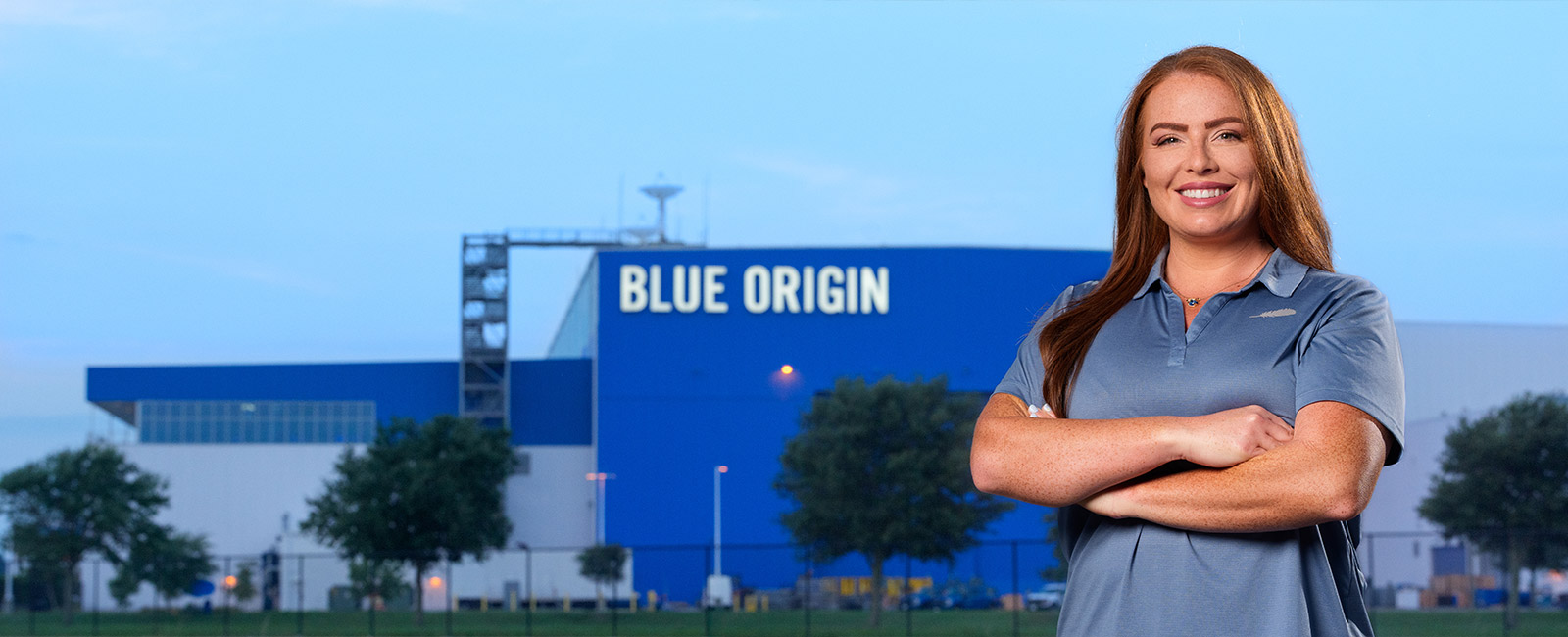
That’s why today, she’s an integrated vehicle test engineer at Blue Origin, where she helps test the complex systems of the New Glenn launch vehicle.
But the journey from space kid to aerospace engineer was cluttered with obstacles and space junk. And she has advice for students who also want to pursue a STEM degree, but are worried they can’t cut it.
“When I started my academic journey, there were kids who wanted to be astronauts, but there was no one talking about the realistic path to become one and how hard it is,” she says. “I just think it’s so important to be transparent. STEM is different than other majors, they say as long as you score around the average, you’ll pass.
“That’s proven to be true multiple times where the average on an exam was 40/100,
but with the curve you end up getting a ‘B’. I had a really hard time with that, before
I got into engineering I was making mostly As and Bs and I remember feeling like such
a failure because I had to repeat a few classes. A lot of people give up when that
happens; I was advised to give up. What I didn’t realize at the time was that a lot
of those STEM classes thoroughly cover complex topics and most students have to repeat
classes like calculus, physics, and statics in order to fully comprehend all that’s
being thrown at them.”
There were times when she was ready to give up.
Although she was born in Florida and spent her childhood watching shuttle launches, Gloria’s journey started in Texas, where her family moved while she was in high school.
After graduating from high school in Texas, Gloria was accepted by her dream school,
Embry-Riddle Aeronautical University in Daytona Beach. But she couldn’t afford tuition
at the private school, so she decided to enroll at the University of Texas at Arlington.
“When I started college I was making decent grades, a few As mostly Bs, but every
semester when I met with my advisor, he constantly tried to talk me out of engineering
because I started off in low-level mathematics, algebra.” Gloria recalls. “It was
a struggle. I couldn’t understand why, if I showed such a strong interest in space
and STEM, I was told over and over again to pursue a ‘realistic’ degree, one that
could be finished in a four-year degree plan, like business. I finally convinced them
to declare my major as aerospace engineering, and ultimately ended up doing poorly
-- failing physics and calculus due to the lack of learning support at the university.”
The experience taught her an important lesson. Although many educators and guest speakers
tell elementary and middle-school kids to pursue STEM careers, they don’t equip them
for how hard the courses will be – and what to do if you are struggling.
Discouraged by her experiences at UT-Arlington, Gloria moved back to Florida in 2015
and worked until she obtained residency. She never stopped wanting a college education,
so she transferred to Valencia College and tried again to pursue a degree in aerospace engineering. At Valencia, she met with advisors, who didn’t frown on her bad grades but understood
she needed tutoring and extra support to achieve her goals.
She also discovered that Valencia College could open up opportunities that wouldn’t have been available to her at a four-year university. Through multiple pilot programs with Valencia – those designed for students at community colleges -- she landed internships and undergraduate research opportunities with organizations such as Siemens and NASA.
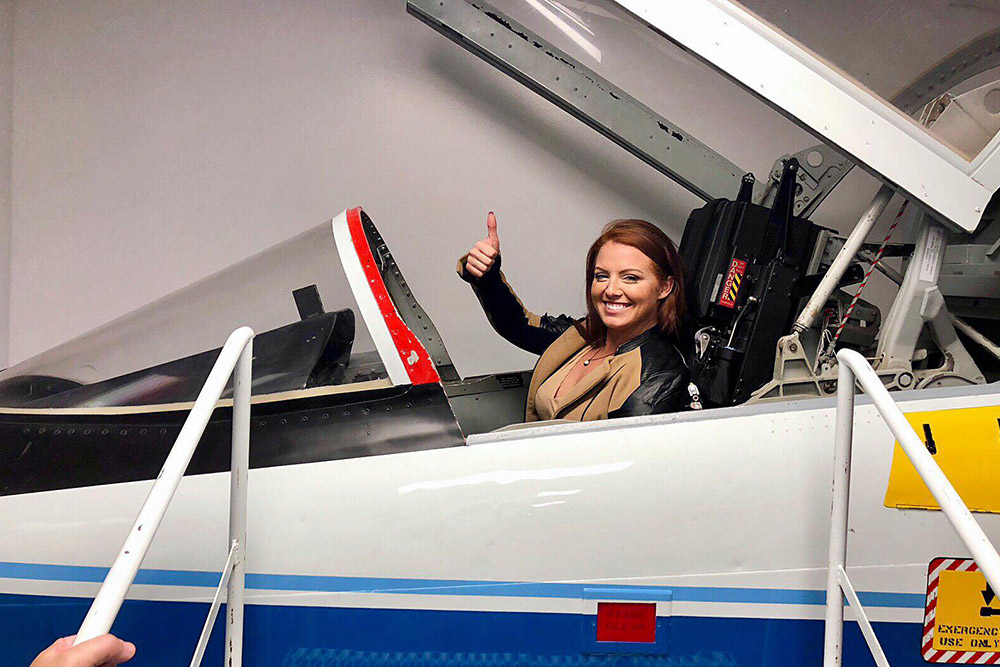
Before Jillian Gloria began working at Blue Origin, she worked for United Launch Alliance and interned with the UCF physics lab and Siemens Energy.
At Valencia, she also connected with a STEM advisor, who not only gave her tangible
academic goals to achieve, but who consistently provided her with opportunities to
build her resume – including a summer internship at Siemens Energy and her very first
Research Experience for Undergraduates (REU) through the UCF Physics Research Exchange
Program, which provides students currently enrolled at UCF DirectConnect partnering
institutions with 10-week summer research experiences in laboratories in UCF’s physics
department.
Through that program, Gloria conducted NASA-funded research and became a published author for her undergraduate research at UCF, investigating the effects of solar and galactic radiation at the surface of airless bodies in space like the moon, Mars, and near-Earth asteroids.
“Valencia saved me and saved my dreams,” says Gloria. “I wouldn’t be here without
the tutoring center. I was never great at math… I tried to take physics for fun in high school… it was
just too hard , I didn’t understand it. The math tutors at Valencia surpass any level
of personal tutoring you can buy! They truly care about the academic success of their
students, and I’m living proof. They walked me all the way from college algebra through
differential equations.”
Eventually, Gloria even became a tutor at Valencia – first in math and then in physics.
After transferring to UCF, Gloria also began working at Exolith Lab, a UCF lab that
makes the highest-fidelity “moon dirt” for NASA and over 1,000 organizations worldwide.
She also participated in a research group that studies the stresses that materials
undergo at hypersonic speeds.
Gloria graduated from UCF in 2022 and landed a job at United Launch Alliance as a
propulsion systems test engineer, where she helped launch more than a dozen successful
missions across three launch-vehicle programs (Atlas V, Delta Heavy, Vulcan Centaur.
Today, Jillian Gloria may be on top of the world at Blue Origin, but she vividly remembers
that time when all she wanted was to get her foot in the door of the space program.
And she offers some solid advice to Valencia students in the same situation.
Even with a GPA that wasn’t high enough for a NASA internship, Gloria never quit trying.
She applied for internships on NASA-related initiatives – and succeeded in getting
a start.
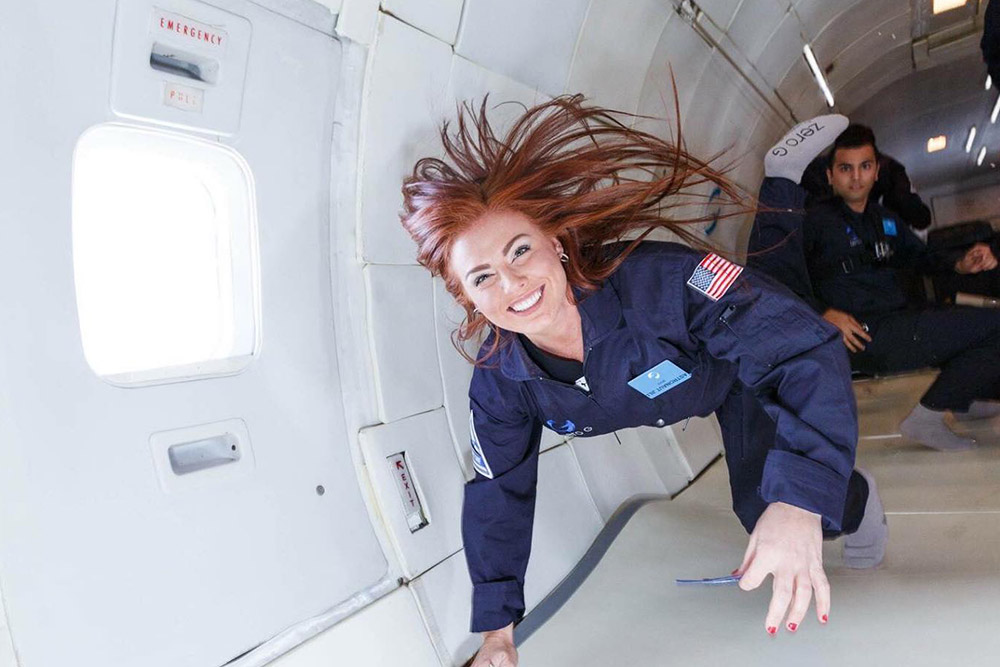
Jillian Gloria never gave up on her dream of working in the space industry, even when it seemed impossible.
“I know it’s discouraging,” she says. “But you have to try to think outside the box. Even if you can’t apply somewhere that has a strict GPA requirement, there are so many different opportunities that you can take part in.
“If one door’s closed, find another way. If you’re passionate about something, there’s nothing that’s going to stop you as long as you have the passion and perseverance to bring that dream to fruition.”
At Valencia College, we work every day to create a level playing field for college students of all backgrounds, fashioning a college where every student can succeed. And our students continue to amaze and surprise us. Read more of their stories.